
How Do I Raise My Self-Esteem and Confidence?
They look confident. They speak confidently. They perform confidently.
But inside? That’s often a very different story.
One of the things people don’t always realise is this—many assume that going to a therapist is only about addressing mental illness. And yes, that is often part of the work. Therapy can support people in coping with diagnosed conditions such as anxiety or depression, navigating emotional challenges, or making sense of experiences that come with being abled. But what is less commonly spoken about is this: therapy is not just about illness, it is also about understanding yourself.
Especially for young people.
Adolescents are incredibly skilled at appearing confident. What we often see on the outside—confidence, humour, even arrogance at times—can actually be a form of protection. A way of masking what is happening internally. I see this a lot in my work. Young people who are high performers on the outside—articulate, capable, even admired—yet quietly carry a deep sense of “I’m not enough” or “I don’t deserve this.” And this is where the conversation around self-esteem and self-confidence becomes important.
Self-confidence is about your belief in your ability to do something.
Self-esteem is about the value you place on yourself.
You can be confident in certain areas of your life and still struggle with your sense of self-worth. Healthy self-esteem is quieter. It shows up when you don’t take everything personally, when you can let go of imperfections, and when you focus on doing your best rather than only worrying about the result. Low self-esteem often builds over time—from comparison, pressure, or not feeling seen for who you are.
So how do we build it?
Not through a checklist—but through small shifts.
So What Actually Helps?
Instead of thinking in terms of “fixing” self-esteem, it can help to think in terms of building a different relationship with yourself.
That shift is subtle—but powerful.
For example:
Rather than focusing only on results, many young people benefit from learning to notice their effort.
Not just “Did I win?” but “Did I try?”
Instead of aiming to be perfect, it becomes about learning how to hold imperfection without shame.
To say, “That didn’t go the way I wanted—and that’s okay.”
There’s also something important about recognising strengths—not just achievements, but qualities.
Kindness. Curiosity. Persistence. Creativity.
These don’t always get measured, but they matter deeply in how a young person builds their sense of self.
And then there’s the role of environment.
Who you’re around, the spaces you’re in, the kind of conversations you’re part of—these all shape how safe you feel to be yourself.
Confidence grows much more naturally in spaces where you don’t feel constantly evaluated.
The 5 C’s—A Simpler Way to Think About It
If we had to simplify what supports both self-esteem and confidence, it often comes back to a few key foundations.
It’s not something young people need to memorise—but something they can slowly recognise in their own lives:
- Clarity – understanding who you are, beyond what you achieve
- Compassion – how you speak to yourself, especially when things go wrong
- Connection – having people and spaces where you feel seen and accepted
- Courage – being willing to try, even when you’re unsure
- Consistency – showing up in small ways, repeatedly
These aren’t things you “master.”
They are things you build over time.
Therapy as a tool to develop self-esteem:
Therapy is an umbrella term. At Mindkshetra, we offer both talk therapy and art therapy.
While talk therapy helps young people put words to their experiences, art therapy offers another pathway, especially for those who find it hard to express what they are feeling.
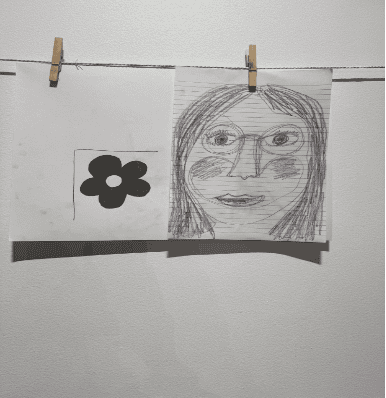
This is also where art therapy becomes powerful. Art therapy is not about creating something perfect or “good.” It is about expression. For many young people, putting thoughts into words can feel overwhelming. But when you draw, paint, create patterns, or even repeat simple lines, something begins to shift.
Your hands slow down.
Your breathing settles.
Your thoughts begin to organise themselves.
Art becomes a way to externalise what is happening internally.
When a young person draws themselves as a small figure in a large space, or uses darker tones repeatedly, or struggles to fill a blank page, these are not just creative choices. They reflect how they see themselves. And over time, through guided art-making, they begin to experiment with new ways of seeing themselves.
Adding colour.
Taking up space.
Changing the narrative.
Art therapy gently builds self-esteem by helping young people experience:
“I can create.”
“I can express.”
“I can exist without being judged.”
And that is powerful.
A Note for Parents Reading This
Sometimes what looks like confidence is actually protection.
A young person who appears overly confident, dismissive, or even uninterested may not be lacking confidence—they may be protecting themselves from feeling not good enough.
And sometimes, the young people who seem the most “put together” are the ones who feel the most pressure internally.
Instead of focusing only on behaviour, it can help to stay curious about what’s underneath it.
Not every conversation needs a solution.
Sometimes what builds self-esteem is simply feeling understood.
Coming Back to You
If you’re a young person reading this, you don’t need to suddenly become more confident.
You don’t need to “fix” yourself.
You can start much smaller than that.
Start by noticing how you speak to yourself.
Start by allowing yourself not to get everything right.
Start with recognising that your worth is not something you have to earn.
That shift—however small—is where self-esteem begins to rebuild.
And finally—
A simple reflective exercise:
Take a seat.
Grab a pen and paper.
Write down 50 adjectives that describe you.
Not just achievements—but qualities, traits, ways of being.
Then pause.
Notice how it feels.
Was it easy or difficult?
Did you get stuck?
Did it feel uncomfortable to write positive things?
That feeling—that’s where your work begins.

Written by:
Rupa Parthasarathy is a cultural artist, art psychotherapist, counsellor, clinical supervisor and founder of Mindkshetra, a Western Sydney–based creative wellbeing studio and social enterprise. A first-generation Indian Australian and native Tamil speaker, she works at the intersection of culture, art and mental health, helping young people and communities integrate creative practices into everyday wellbeing. In 2025, she received the South Asian Women in Business Award for her work through Mindkshetra.
More Articles: